High-agency business problem solver

I solve difficult business problems.

I understand the system, find the real constraint, and build whatever is needed: a product, process, marketplace, growth engine or operating model.

Across ₹2,500 Cr marketplaces, zero-to-one businesses and tools built because a problem would not leave me alone.

What happens when the problem is messy

01See the systempeople · incentives · data
02Find the constraintsymptom ≠ root problem
03Build the missing layerproduct · process · model
04Make progress visiblemeasure · learn · compound

The output can change completely. The sequence stays disciplined.

Company work · 2011–2026

Choose a case.
Explore the thinking.

Six chapters, shown newest first. The summary gives you the complete arc; “Enter the full case” opens the decisions, systems and evidence.

The question

How do you rebuild a service when growth, trust and transaction control are breaking at the same time?

Problem

Genie was closest to the wedding customer at the start, but fragmented context made it weakest at quote, visit, negotiation and closure.

Insight

Low revenue was the symptom. The deeper constraint was the absence of one operating system connecting the client, venue and Genie.

Build

Redesigned the journey around qualified demand, venue intelligence, better representation, a private client portal, quote intelligence and CRM automation.

Outcome

₹5L → ₹20L average monthly revenue in three months

Diagnose
Align incentives
Build the system
Make it compound
Enter the full case

WedMeGood · 2026

One broken funnel.
Three connected problems.

Genie was closest to the customer at the start, but weakest at the moments where trust, conversion and commercial attribution were decided. Solving it meant redesigning the journey around the client, venue and Genie together.

01 / Latest work

Rebuilding Genie

Latest problem solved · 2026

₹5L → ₹20L

average monthly revenue in three months

9/month → 9/day

qualified leads reaching Genie

None → 95%

from no shared CRM to 95% record completeness

01 / Diagnose

Low revenue was the symptom. Loss of control was the constraint.

There was no shared CRM when I arrived. Lead status lived in personal Google Sheets, pen-and-paper notes, individual memory, or was not recorded at all. That made requirements, quotes, follow-ups and venue context invisible, and left Genie weakest exactly where trust, conversion and attribution were decided.

No shared system of recordGoogle Sheets · pen and paper · memory · sometimes nothing
Operational consequenceLead status, requirements, quotes and follow-ups stayed invisible
Core constraintGenie lost control where value was decided

The system that emerged

Five layers. One compounding loop.

Each layer creates the information or control needed by the next.

01Qualified demandRight client context
02Venue intelligenceCohort + fit
03Client portalClarity + trust
04Quote intelligenceSpeed + leverage
05CRM automationVisibility + action
CALLSWHATSAPPZOHOCLIENT PORTAL
Every verified conversation enriches the same data bank.

Customer intent, venue fit, quote history, preferences, actions and outcomes become reusable context for matchmaking, negotiation, follow-ups and future products.

The system in practice

Three views. One operating model.

Representation, operating control and the client experience reinforce one another. Choose a view to inspect the evidence without leaving the case.

01 / A+ profiles

Better representation makes the right venue easier to understand.

Raw venue inventory became a client-safe decision tool: ideal customer fit, layout, stay, ceremony and practical watch-outs explained visually before the sales conversation.

Sharper fitBetter understandingMore credible shortlists
Example of an eight-card Genie A+ venue profile
A+ stories turn venue information into a decision narrative for couples and families.

The Proven Club · 2023–25

The Proven Club

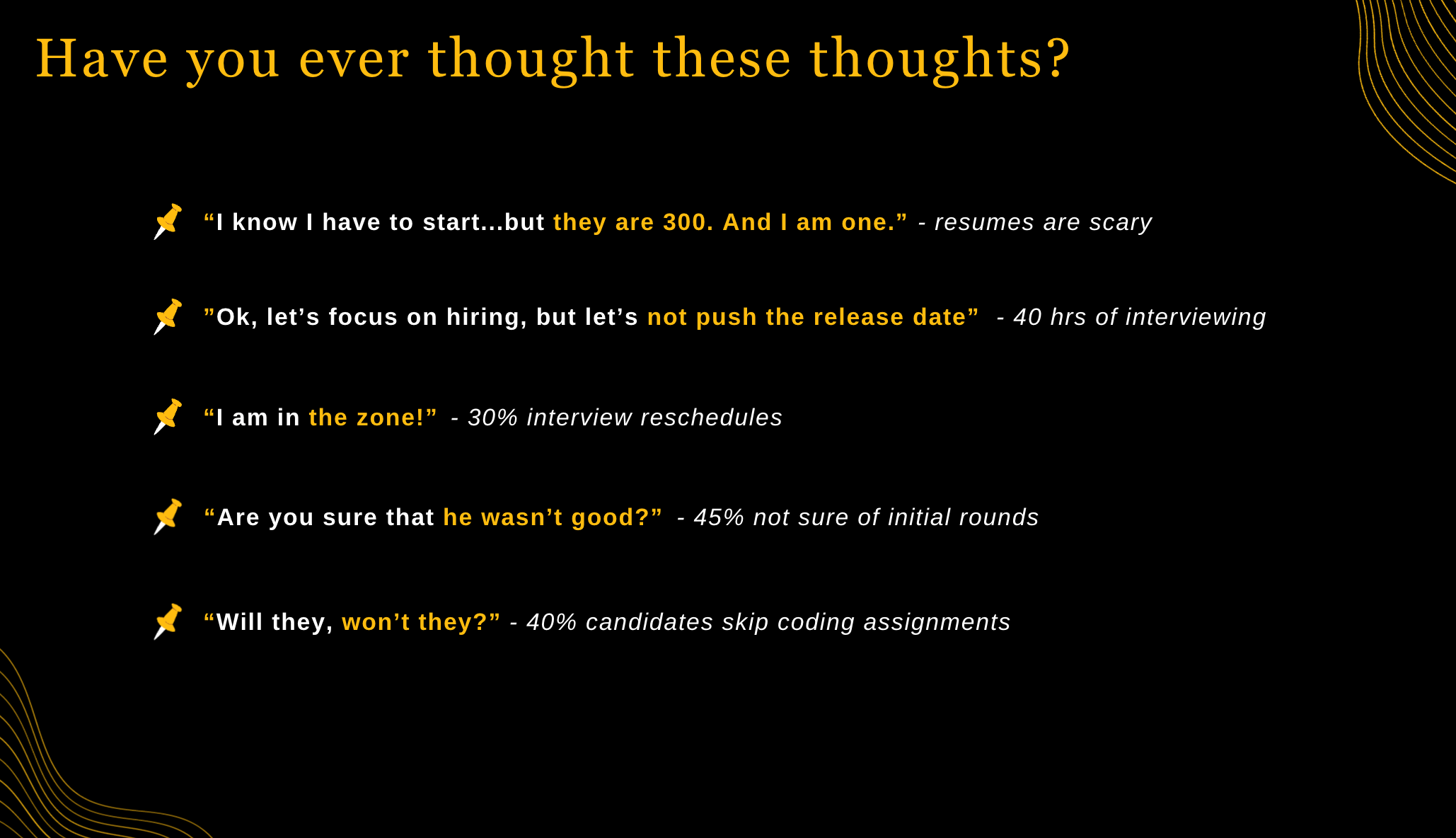
How do you remove thirty hours of engineering effort from one technical hire without reducing the candidate to a score?

₹15L/monthbefore the product launch60% → 95%screening accuracy

Chapter 01 / 07

The interview only became useful after I could see how the candidate thought.

While hiring, I would give candidates a real problem from my role and ask how they would approach it. A strong approach earned the deeper conversation. The first product question was simple: could hiring managers get that window before scheduling an interview?

A résumé showed history. A problem response showed thinking.
Early Proven Club slide describing the recurring pains in technical hiring
The early product slide naming the recurring pains in technical hiring this was meant to fix.
~30 hrsengineering bandwidth per technical hire
3 monthsat roughly ₹15L monthly revenue
<2 secAI interviewer response latency
5 monthsI went back to coding and built the AI interviewer myself

LEAD School · 2021–23

LEAD School

Two growth bets emerged from the field. The work was not only to build both. It was to recognise which problem deserved the company's focus.

Genie · B2B2C opportunity discovery

Could the existing student app become a new learning business for Tier 2 and Tier 3 families?

01 · Starting assumption

The first mandate was academic learning. In 2021, the obvious thesis was to help children in smaller towns study online.

02 · Field truth

A trusted bhaiya, didi or auntie in the colony could teach ten children for ₹150 a month each. Online academics could not beat that combination of price and trust.

03 · Hidden opportunity

Parents proudly showed us dance, drawing and other extracurriculars. The scarce thing was not another academic tutor. It was access to good extracurricular teachers nearby.

What I owned and built

I took the opportunity from field research to strategy and PRDs, shaping an online product for spoken English and creative skills.

Outcome$1M ARR

business built before it was deliberately parked

The product worked. The low-fee-school opportunity was roughly ten times larger, so we reallocated focus instead of confusing validation with priority.

Flipkart · 2015–21

Flipkart Fashion Wearables

Two connected levers changed the category: manufacture competition where the market had none, then allocate discounting capital according to measured price response.

Starting growth16%vs fashion near 40%
Annual GMV₹1,600 Cr → ₹2,300 Crroughly 44% growth
Festive return₹50 Crunused subsidy returned

Decision 01 / 04

The category was not short of demand. It was short of competition.

Fashion Wearables was a ₹1,600 Cr business growing at 16% while fashion grew near 40%. Watches and sunglasses contributed half the category, yet a handful of brands sat comfortably in distinct price and identity positions. With little direct competition, even festive discounting remained shallow.

Map the market before asking the incumbents to behave differently.

The white spaces were local, not one empty centre.Each incumbent sat unchallenged in its own position. That was the opening.

Value formalSonataPeter England
Accessible eleganceTitanAllen Solly
Youth and adventureFastrackWROGN · Levi’s · Wrangler
Premium formalFossilLouis Philippe
Dashed: the challenger position each gap invited.

Flipkart · 2015–21

Flipkart Men’s Clothing

The mandate was growth. The unlock was to make four category levers work as one system: selection, pricing, discovery and speed.

Business scale₹1,000 Cr → ₹2,500 Crin two years
Growth58% CAGRwhile rebuilding category economics
Bottom line+300 bpsfrom better efficiency and margins

System decision 01 / 04

We were buying what brands had left, not what customers were likely to want.

Key account managers sifted through old-season stock dumps and largely chose styles with enough S, M and L units. Historical demand was absent from the decision. Worse, a brand having a lot of a style left could be evidence that customers had already rejected it.

Availability was the last filter. It had accidentally become the first.
Old buying ruleBrand stock dumpS · M · L available?BuyNo historical demand signal
Evidence-led ruleProduct attributesBSKU historySize availabilitySharper order
22–23% → 46%sell-through baseline to Peter England pilot, month one
22 days → <1 daypurchase order to live inventory through AlphaLite
15%of Flipkart Fashion inventory on BBD 2019 handled by AlphaLite
Fresh SMUsturned Flipkart from an old-season outlet into a strategic brand customer

Men's Clothing · Selection intelligence

Evidence changed the relationship with brands.

01BSKU evidenceKnow what should sell
02Fresh SMU ordersMade specifically for Flipkart
03Higher sell-throughFewer returns to brands
04Better economicsMargin, leverage and trust
Clearance channelStrategic customer

Flipkart · 2015–21

Flipkart Reverse Commerce

The internal mandate was Value Recovery: liquidate customer returns faster and at better rates, reduce warehouse inventory and minimise losses.

01Opaque bilateral quotingSlow · concentrated · hard to audit
02Audited RFQ marketplaceVerified vendors · visible bids
03Faster, higher-yield liquidationFinance-controlled decisions
04Exchange ecosystemRefurbishment becomes a growth enabler
Inventory~500 → <100 dayswithin one year · target was 200
Recovery yield+~500 bpsaverage improvement
Illustrative bottom line~50 bpsat a 10% category return rate

Diagnosis 01 / 04

The liquidation problem was real. The market-design problem was bigger.

Returned inventory had reached approximately 500 days while forward sales grew around 60% year on year. We began with mobiles: high-value stock with a relatively organised secondary market and a visible yield gap.

Flipkart generally recovered 55–60% on returned mobiles; the best Apple models reached approximately 75–76%.
Apparent problemSlow liquidation + poor recovery yield
Underlying problemOpaque, concentrated market · no SOPsStructurally vulnerable to collusion

16vendor entities

~12connected to

4underlying groups

My ownership

Root-cause diagnosisMarket + process redesignTeam + vendor rebuildRFQ product partnershipProduct Exchange collaborationCategory coordination

Coca-Cola · HCCB · 2012–15

Breaking the growth cycle.

Across Mumbai’s western suburbs, the mandate was to replace alternating growth and decline with a territory that could grow consistently.

01 · PatternOne year up.
One year down.
Five years of performance confirmed that growth was cyclical.
02 · FrontlineMonthly targets became outlet-level action.Beat, day, outlet and brand targets made the opportunity usable.
03 · ReachInformal influence became formal distribution.Local wholesalers entered the system as authorised partners.
04 · ResultThree years of consecutive growth.11% · 5% · 8%

01 / Give the frontline evidence

Move the sales conversation from “Any order?” to a specific recommendation.

On the last Thursday of each month, each market team reviewed the previous year’s outlet- and brand-level sales by beat and week. Salespeople then set their own outlet targets—often above the top-down number—and entered the market knowing what had sold before and what to recommend next.

Last year’s outlet salesToday’s brand opportunityEvidence-led order

02 / Redesign route to market

Work with local market power instead of routing around it.

Influential wholesalers in underserved pockets became authorised sub-distributors; one became a distributor during my tenure. In key markets, passive legacy operators were replaced with younger entrepreneurial distributors who wanted to follow the system, improve coverage and earn returns through execution.

Untouched pocketsAuthorised local partnersReliable reach
New outlet coverage~300 2,000outlets opened in one year versus the earlier average
Territory growth11% · 5% · 8%three consecutive years
RecognitionBest ASMMaharashtra
Consistent growth came from giving frontline sellers better information, turning informal market power into formal distribution and putting the right entrepreneurs behind execution.

What I owned

Territory diagnosisFrontline planning systemOutlet-level selling cadenceWholesaler partnershipsDistributor selectionExecution discipline

Wipro Consumer Care · Andhra Pradesh · 2011–12

Making growth available.

Modern-trade demand was not enough. Growth depended on placing the right stock behind it, then aligning the field organisation and channel partners around execution.

01 · SeeTrack weekly chain stock.Make availability visible before it becomes a lost sale.
02 · SetCreate distributor-by-SKU stock norms.Use the previous two quarters of sales to correct replenishment.
03 · AlignReward execution across the channel.Connect merchandisers, chain relationships and local activation.
Business₹14.5 Cr ₹24.3 Crin one year
Target achievement131%of the assigned target
Fill rate40% 70%across retail chains
Pharma chains₹1 lakh ₹30 lakhper quarter across Apollo and MedPlus

Availability before promotion

Past sales became the operating rule for future stock.

Weekly chain stock tracking exposed availability gaps. Distributor- and SKU-level stock norms, based on the previous two quarters of sales, corrected replenishment for high-selling products and raised average fill rates from 40% to 70%.

Supporting breadth

Build the channel and the execution layer together.

Store-staff incentives and relationship building expanded Apollo and MedPlus, while new chains, unconventional outlets, promoter incentives and local activations opened additional growth.

Team led

5 sales officers · 3 brand-advisor executives · 75 promoters and merchandisers

What I owned

Modern-trade salesAvailability planningChain relationshipsField incentivesLocal activation
Availability turned promotion from an event into a growth system.

How I solve

Start with the system.
Stay until it works.

The job is not to produce a strategy. The job is to make the strategy survive contact with people, incentives and daily execution.

01

See the system

Customers, incentives, economics, product, operations and data.

02

Find the constraint

Separate the visible symptom from what is actually stopping progress.

03

Align the actors

Create value for every stakeholder who has to make the system work.

04

Build what is missing

A process, product, CRM, automation or operating rhythm.

05

Make progress visible

Measure, learn and intervene before a miss becomes a story.

About

I am most useful when the problem is important, messy and not owned neatly by one function.

I have worked across marketplaces, consumer products, education, wedding services, growth and operations. My work usually begins with an open question and ends with a working system.

I am comfortable moving from founder-level strategy to field visits, process details, product flows, code and the weekly operating review. That range is not a side effect of how I work. It is the point.